

(3) Demand for Tangibility
How we classify value on craft, endless commodification, and the other side of it.

I would like to think that I learned to draw from my dad. Although he never sat down to show me how to draw, flipping through his various sketchbooks and copying them, I felt like I was creating towards something. I envisioned that one day, I too would have a thick collection of sketchbooks to show that I had been creating. My dad wouldn’t consider himself an artist, per say, although growing up, his sketchbooks were some of the most valuable keepsakes that I would frequent like my favorite storybooks.
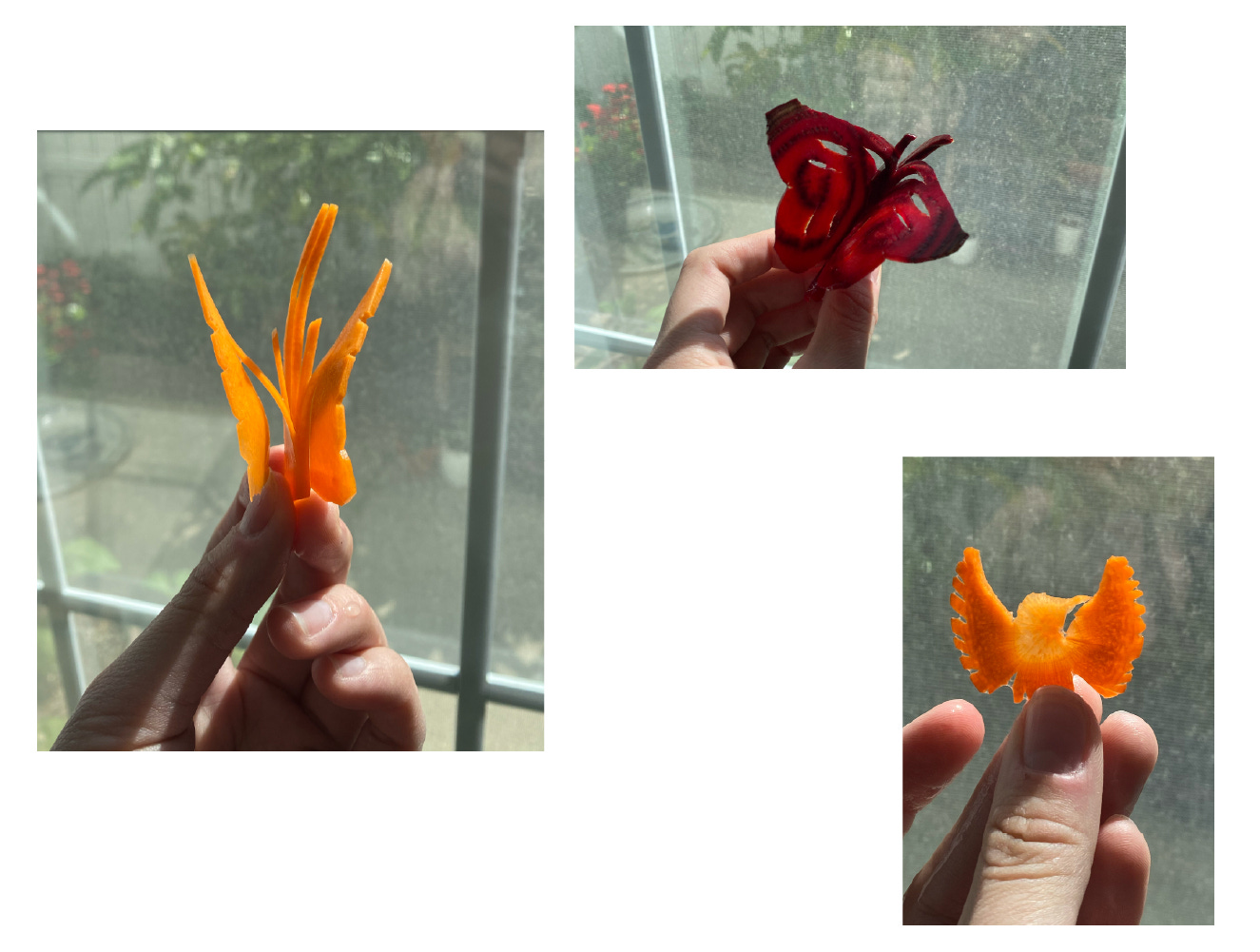
When my dad started making sushi in the states, I thought his food was art, though the world stamped it to be blue-collared labor. A few weeks ago, he was exploring ways to elevate the eating experience through edible decorations. When he carved little birds, butterflies, and flowers out of carrots and beets, I was deeply moved. There was so much precision and intentionality in his craft that would go amiss if one did not know the full length of this work. Unfortunately, his employer was unimpressed. Apparently, his art didn’t hold much value nor potential when the namer of its commodity value decided to classify it as such. I felt upset watching him preserve his unused carvings in a water cup, to then toss them entirely in the trash. I wanted to keep them, save them if I could.
I wondered, would his carvings hold more value if they were served on a different platform than on a dinner platter? Where does the value of craft come from?
Naming craft value is often contingent on tangibility: we must see it to believe it; we must prove ourselves with incessant production. This is ironic because surely the artist came before the artwork. First is the artist with the idea, intrepid and raw, and second is the product. But unfortunately, an idea is not enough. An idea falls short without a vessel to hold it. An idea incepts through a medium, the medium is held by a repository, the repository, known and acknowledged. Perhaps this is why designers make instagram art accounts, scholars enter academic institutions, and I am here writing my substack, in hopes of leaving trails of my ideas into something more tangible.
In The Pleasure x Effort Matrix, Shea Fitzpatrick shares,
“I realized that the only social affirmation I received was for things I did or produced. I felt accepted by my friends and a community of artists, but that acceptance felt conditional on continuing to “do X” or “be into Y.” I didn’t even like doing what I was being praised for…
There is a real capitalist incentive to have legible and commodifiable ‘interests’ that form a personal brand…”
Digital commodification is not new to us. The archive of artworks on instagram signifies one’s value as an established artist. The list of ranked books on goodreads proves one’s value as an active reader. The high digits of minutes listened on spotify assures one’s value as a musical whiz. There is pressure to perpetually commodify one’s talent/hobby/niche online because 1) everyone is doing it and virtually everything and anything has a chance at commodity 2) organic modes of garnering capital and recognition are now nearly impossible.
One of the reasons why I do not have tiktok is because as someone who loves creating, I would feel the urge to produce on this platform, to commodify myself and my thoughts. I am not trying to shit on people who are brave enough to start something on social media nor discount their labor and intentionality behind their works. But when did commodifying oneself on a digital panopticon become a very natural step towards value-naming as a creator? I am not sure which is worse, condoning a unilateral relationship with the platform that relies on systematic consumption or incessant self-commodification for a chance at virality and capital. We subvert to find something in between, but subversion is not commodity-immune. It is just a temporary remedy.
Value judgment is fixated on external engagement where the world becomes a critic. When one assumes the identity as an “artist”, people want to see the product. They jump, “What do you make”, “Can I see your art?”, “Can you make X for me?”. The questions are rarely about the thought that preceded the output itself. My dad is one of the most prolific artists I know. At home, he is always creating: brush calligraphy, flower arrangements, cooking, gardening, poetry, his explorations never end. But his work is never public, just personal. If my dad had a social platform of 200K followers to share his vegetable carvings, perhaps the societal outlook on the worth of his art would be different. But because they are disposable and their presentation happens to be a ubiquitous restaurant plate and not a gallery, because he never had a personal brand to begin with, he is not an artist by societal standards.
But what if ideas were enough? What if we, as people, were enough to hold our ideas as art? I know this sounds nice in theory — I am especially restless when it comes to creating. But more recently, I’ve been thinking about how my friends are my most immediate vessels. Some of my most artful and enthralling explorations in craft have been through conversations with friends who allow me to dig deeper into my inquiries. Their holdings of my ideas birth tangibility through their curious engagement and love for me. And what is art if not just seeds of curious conversations and wondrous explorations in community? Or if not just a series of words and strings of thoughts woven together to serendipitously birth new ideas, to then somehow find a home that may or may not be tangible? Most of my thoughts currently do not hold tangibility. There is peace in knowing that there is no need to turn ideas into commodified products to justify their value.
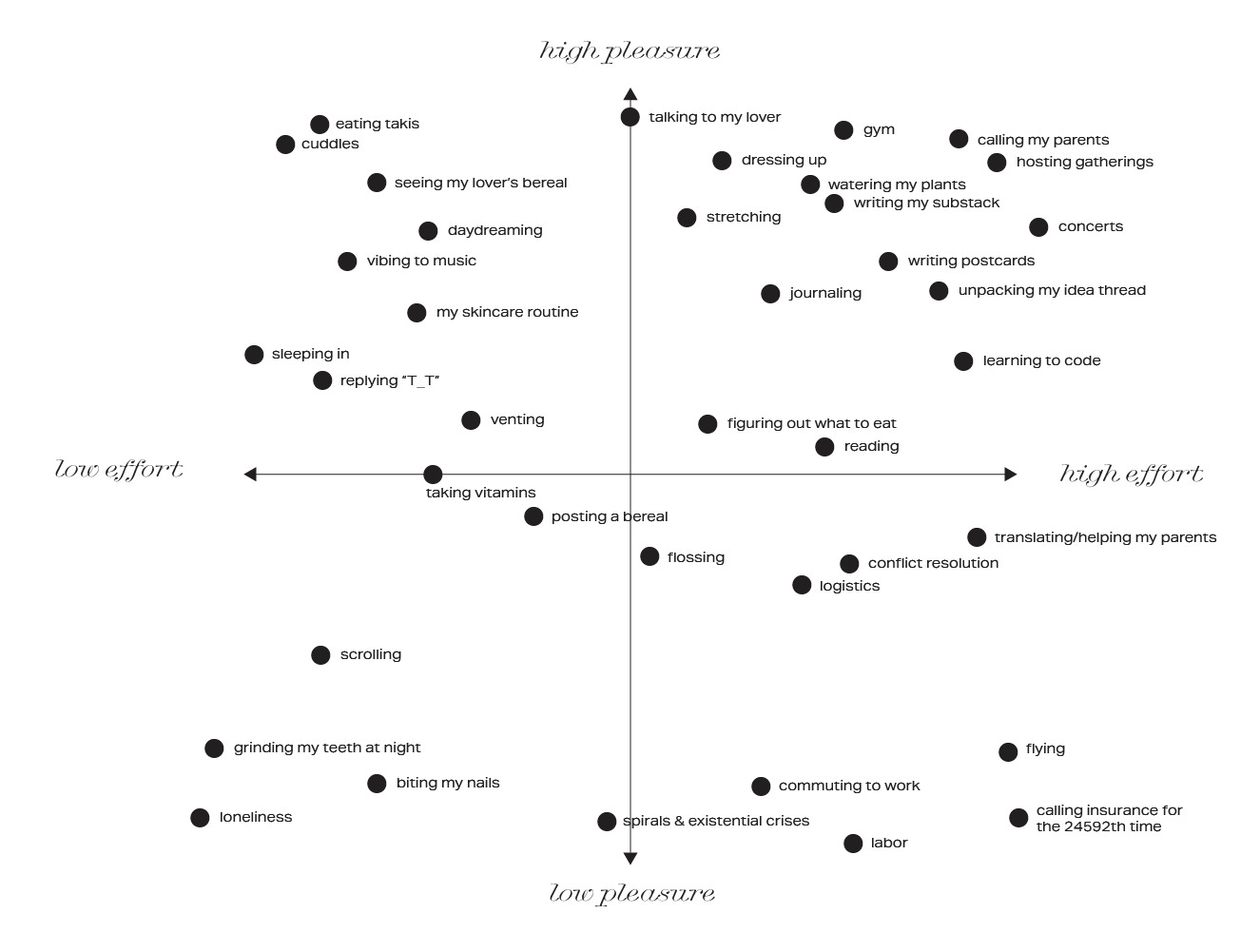
I love Shea Fitzpatrick’s pleasure x effort matrix because it is an exercise that calls for self-reflection and re-alignment. Knowing myself, I almost always function in the first quadrant: high pleasure x high effort. I am relentless when it comes to self-growth and discipline, but there is a real sense of pleasure in these activities that they have become routined. My sense of will (to live, to be, in my selfhood, etc.) relies so much on my self-satisfaction for growth that I exist in a never-ending expansion of my first quadrant. During a conversation with my roommate Vibhuti (who has also assumed many roles such as my therapist, doctor… thought partner, etc…), she asked if I hold a scarcity mindset for my creativity. For the first time, I wondered if my fixation on growth and pursing things that are high pleasure x high effort is because I treat a lot of things as a scarcity (time, creativity, youth, money, etc.). Looking at my graph, I understand that the pleasure of these activities will always be in flux depending on various factors. Interestingly enough, a lot of activities in the first quadrant require a form of production, alone and in partnership, whereas other quadrants rely on just being (or coping).
I would like to think that I have learned to create for the sake of creating, and not for value affirmation or commodity. My understanding of value in my craft comes from my personal relationship with the craft. This value exists in secrecy, in my private arena, and such a self-fulfillment does not require a public domain online or an audience to measure my worth. This is something I partially learned from my dad. His practice in art is all about building personal, private relationships. I see this the most in his little garden. Every winter, he refuses to pick the oranges from the tree — he does not see them as commodity for consumption. My mom and I often ask him, aren’t we supposed to pick the oranges so the tree can grow more? He replies, normally, yes. But I don’t grow it to eat it (my mom groans here). He just sees the tree: orange dots against the green against the blue and loves it as art.
Thanks for creating with me.
— Eileen
Eileen, you are a beautiful vessel! I found your ideas and thoughts here to be so full . My dad once told me that we are the captains of our bodies/minds. Though we may not be able to choose our vessel/ship, we can do our best to steer it. I hope for your vision that we may all one day see each other and our own livings and tryings as the art itself. :))
i loveddd this piece! i love especially the question of what comes before the art, rather than being so consumed by the after. reading this reignited a desire to create for the fun of it :’)